

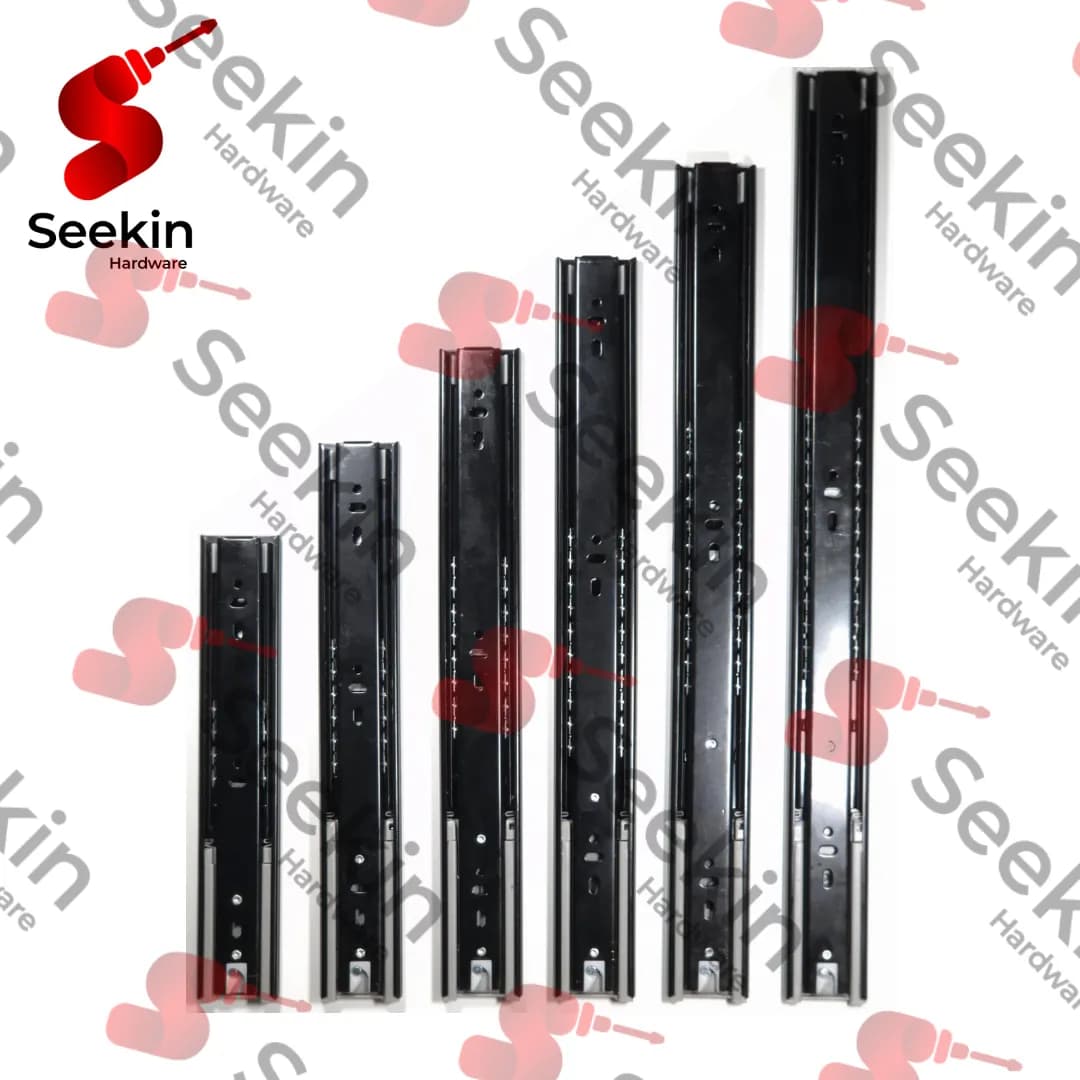






Soft-close slides install the same way as ordinary ball-bearing slides, but they are less forgiving about alignment. If the left and right rails do not match, the drawer still opens, yet the soft-close never pulls it fully shut. This guide covers both 35mm and 45mm slides.
What you need
- One pair of slides per drawer, sized to the cabinet depth.
- Flat head screws, 13mm or 16mm. Screw heads must not stick out into the bearing track.
- Tape measure, pencil and square.
- Drill or screwdriver, and a small bit for pilot holes.
- Calipers to measure rail thickness, if you have them.
1. Measure and calculate
Measure the inside width and depth of the cabinet. The drawer box is the inside width minus two rail thicknesses, usually about 25mm. The box length equals the slide length. The full calculation is in our 35mm vs 45mm guide.
2. Separate the inner and outer rails
Pull the slide out to full extension. There is a small plastic lever in the middle. Press it while pulling the innermost rail until it comes off. The inner rail goes on the drawer; the outer rail, which holds the bearings and the soft-close unit, goes in the cabinet.
3. Mount the outer rails in the cabinet
- Draw a level line on each inside wall at the same height. Measure from the cabinet floor, not the room floor.
- Set the front position. For a drawer front that covers the cabinet edge, the rail sits flush with the front edge. For an inset front, set the rail back by the thickness of the front.
- Screw through the slotted holes first, so you can still adjust.
- Repeat on the other side and check both rails are the same height from the cabinet floor.
4. Mount the inner rails on the drawer
Fix each inner rail along the middle of the drawer side, front end flush with the front of the box. Both sides must be at the same height. Use the slotted holes first, as with the outer rails.
5. Fit the drawer
Pull the cabinet rails all the way out and make sure the bearing cage sits at the front. Line up both inner rails and push the drawer in gently until it clicks. If it feels stiff at the start, do not force it. Pull it back out and check the bearing cage.
6. Adjust and lock
- Open and close the drawer a few times. It should run without catching.
- Push it to about the last 5–10cm and let go. The soft-close should pull it shut.
- If it runs crooked or does not close fully, shift the rails in the slotted holes until they match.
- Once it runs well, add screws in the round holes so nothing moves.
Do not slam the drawer to test the soft-close. The damper is built for a normal push, and repeated slamming shortens its life.
Common problems and causes
| Symptom | Most common cause |
|---|---|
| Drawer drags or feels heavy | Side gap too tight, or screw heads sticking out |
| Drawer does not close fully | Left and right rails differ in height or depth |
| Drawer wobbles sideways | Side gap too wide |
| Front of drawer sags | Load above the slide rating, or 35mm slides on a heavy drawer |
| Drawer comes off when pulled | Inner rail not engaged with the bearings when fitted |
Need slides in volume for kitchen or wardrobe production? Send the quantities and sizes on WhatsApp for bulk pricing.